I’m reading through at the moment. The chapter linking the work of to the ideas of is very interesting and I am getting my head around some of the ideas.  Solid and get a namecheck, which is pretty much just under a different guise.

(Most of the chapter from the book is also available online here: Fanon and (digital) self-determination).

A better way to understand what we mean when we talk about privacy, then, is to see it as a right to self-determination. Self-determination is about self-governance, or determining one’s own destiny.

I think there are some parallels with what said here:

p2p networks weren’t primarily about evading surveillance, evading copyright, or maintaining anonymity, but one of netwerk-resilience and not having someone with power over the ‘off-switch’ for the entire network

Future Histories:

digital privacy—and its philosophical twin, freedom—involves anonymity, secrecy, and . Autonomy is not just evading surveillance. Autonomy means the freedom to act without being controlled by others or manipulated by covert influences.

I am going to read Ton’s posts on networked agency, as I feel like there is a connection there. (And they will be good, even if not).

Self-determination is both a collective and individual right, an idea of privacy that is much more expansive and politically oriented. It is about allowing people to communicate, read, organize and come up with better ways of doing things, sharing experiences across borders, without scrutiny or engineering, a kind of cyberpunk internationalism.

Self-determination, autonomy, agency – it certainly does sound related.
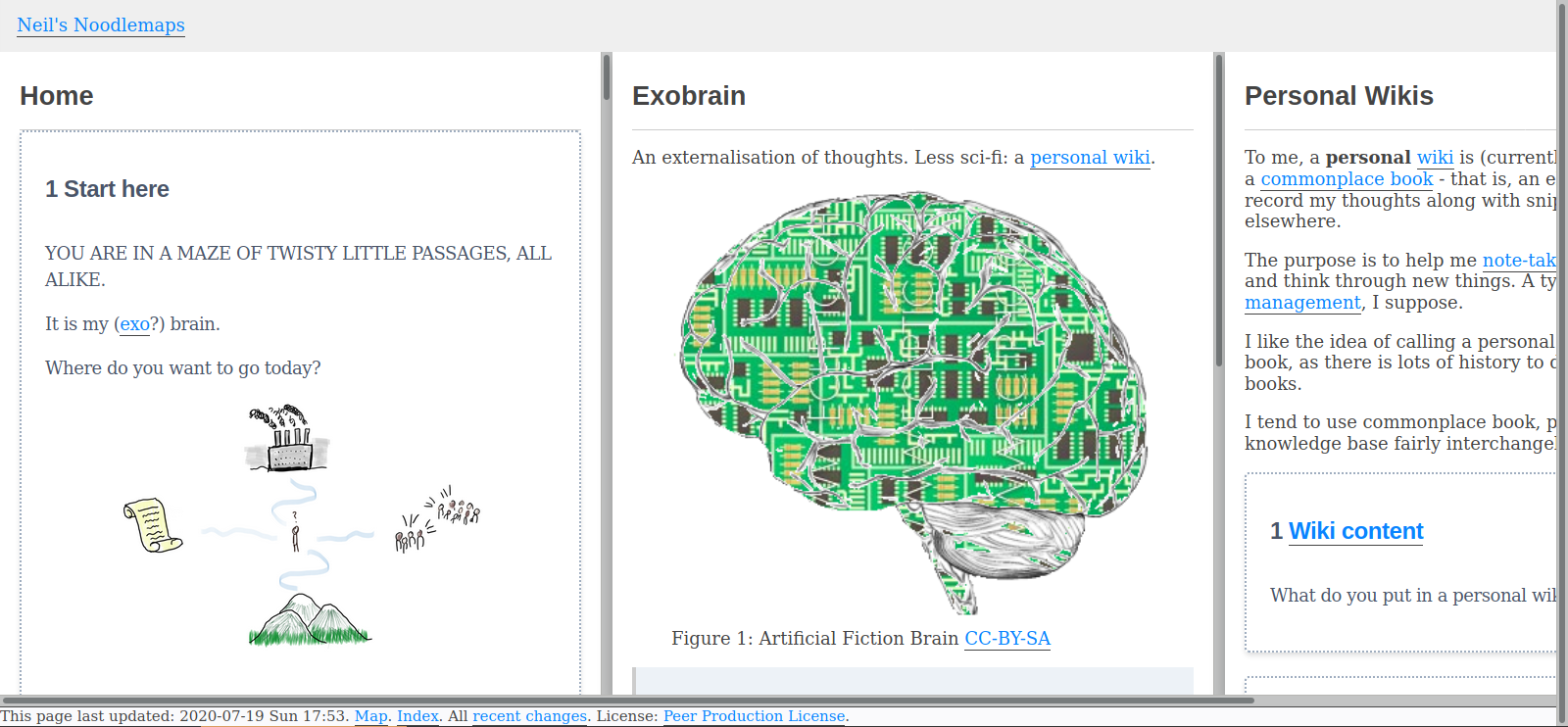
I made my wiki have a view. I like it, I think it works well for wikis.

2020-07-20_20-27-16_xU4hlD4.png

I think it’s probably something that could be a browsing style option built into the browser, rather than forcing it into an individual website, but hey, it’s not, so here we are. Roll on !

I copied most of the code for it from Jethro Kuan’s Cortex Hugo theme (which he says he mostly copied it from azlen.me), and then wrangled it into my org-mode process.

In thin client/thick server models, the server does all the work and has all the power. Any authority for the user to do something is borrowed from the server (which can also remove it at any point).

The society of users in thick-server applications route their actions through the server. When they message each other, they are updating entries in the server’s database. When they publish files, they are writing those files to the server’s disks. The server has ultimate authority over those systems. Users can access the interfaces provided by the server to control them, but the server may override a user’s choice at any time. All authority is borrowed from the server, and so the users possess no authority of their own. As a result we must describe these services as authoritarian.

The tethered economy: the move towards products being persistently linked to the seller after purchase. By software and connectivity. Bad news because the vendor has complete control over your use of the thing and how long it lasts.

Imagine a future in which every purchase decision is as complex as choosing a mobile phone. What will ongoing service cost? Is it compatible with other devices you use? Can you move data and applications across devices? Can you switch providers? These are just some of the questions one must consider when a product is “tethered” or persistently linked to the seller.

The Tethered Economy by Chris Jay Hoofnagle, Aniket Kesari, Aaron Perzanowski…

Starting to read The Telekommunist Manifesto:

The Manifesto covers the political economy of network topologies and cultural production respectively.

Based on an exploration of class conflict in the age of international telecommunications, global migration, and the emergence of the information economy.

the work of Telekommunisten is very much rooted in the free software and free culture communities.

This text is particularly addressed to politically motivated artists, hackers and activists

^ I’m sure it will have its flaws, but can’t deny that it sounds pretty up my street.

A video by Paul Frazee about Beaker Browser.

Paul states some of the goals of Beaker:

  • more software freedom (no code hidden away on a server)
  • lowering the barriers to creating and publishing an app or a website
  • more opportunity
  • having fun – keeping the web individual and diverse

It’s very adjacent to IndieWeb to me. Everyone has their own profile drive, which is kind of like your personal website. All the data is yours – it’s attached to your hyperdrive. Own your data. And apps access the data in your hyperdrive, you don’t send anything to them.

One very nice thing with Beaker, you get your Beaker profile just by running the browser – you don’t need to set up and maintain a server. (No Servers! No Admins!) You also get an easy to maintain address book, where you can basically follow other people.

I like the idea of being able to fork apps easily, too. It’s as if you were using Facebook, but you wanted to change part of the interface, and you could, because you have immediate access to the source and can just fork it and tweak it.

Facebook VP of Global Affairs and Communications, Nick Clegg:

We don’t benefit from hate speech… we benefit from positive human connection.

Nick Clegg on CNN

OK Cleggy. Not so sure about that. You will only care about positive human connection when it makes you money. I’d suggest that those two things are mutually exclusive.

The architecture of the social network — its algorithmic mandate of engagement over all else, the advantage it gives to divisive and emotionally manipulative content — will always produce more objectionable content at a dizzying scale.

Opinion | Facebook Can’t Be Reformed – The New York Times

Via @pfrazee‘s article on information civics, came across this old article of Bruce Schneier‘s on what he calls the feudal internet.

In his analogy, we’re the peasants who have traded in freedom for some convenience and protection.

Users pledge allegiance to more powerful companies who, in turn, promise to protect them from both sysadmin duties and security threats.

He sees the two big power centres of the feudal lords as data and devices.

On the corporate side, power is consolidating around both vendor-managed user devices and large personal-data aggregators.

We no longer have control of our data:

Our e-mail, photos, calendar, address book, messages, and documents are on servers belonging to Google, Apple, Microsoft, Facebook, and so on.

I see the IndieWeb, Beaker, etc as means of resisting this.

And we’re no longer in control of our devices:

And second, the rise of vendor-managed platforms means that we no longer have control of our computing devices. We’re increasingly accessing our data using iPhones, iPads, Android phones, Kindles, ChromeBooks, and so on.

I see the right to repair as a means of resisting this. Allowing us to do what we wish with our own devices – including putting whatever software on them that we want.

One big omission from the article I find is that Schneier focuses on the disbenefits to the users of these devices and platforms – the manufactured iSlaves, in Jack Qiu’s terminology. He doesn’t mention (at least in this particular article) those exploited in the creation and upkeep of these – the manufacturing iSlaves. That’s just as big, if not bigger, a reason for challenging these power structures.

I had not really thought much about the tech firms in this light before – of the undue control they have on computing infrastructure. (I think the author here including both hardware and software platforms in ‘infrastructure’).

In all the global crises, pandemics and social upheavals that may yet come, those in control of the computers, not those with the largest datasets, have the best visibility and the best – and perhaps the scariest — ability to change the world.

Privacy is not the problem with the Apple-Google contact-tracing toolkit

I don’t know if it’s a bigger problem or not than surveillance capitalism though. They both seem like big problems, in tandem.

The distinction between harvesting data and running the platform seems pretty neglible, too. Unless maybe he’s talking about things like Amazon Web Services more than things like Facebook?

Dunno. Regardless, cool to see both right to repair and IndieWeb-adjacent stuff mentioned together as modes of resistance against big tech.