Thinking about ‘bliki‘ (blog and wiki, garden and stream, stock and flow, etc etc) tooling a bit.

[Aside: perhaps if I made some bliki software, I would call it ‘Flock’.. flow and stock…]

What I’m currently doing

For the garden bit, I’m using org-roam. I actually write my stream bits first in org-roam, publish it to HTML, then just manually copy that HTML to WordPress and publish there for all the public stream stuff. As it’s IndieWeb-enabled, WP gets me feeds for people to follow, and all the interactions you’d expect from streams – replies, likes, etc.

So it is manual until it hurts, but it doesn’t hurt too much at the moment. In fact, writing and hyperlinking with org-roam then copying it over is for me a lot more pleasant than writing straight in to WordPress.

But obviously there’s quite a lot of redundancy there.

Where I could go with it

I could use WordPress pages as my interlinked garden. This would have the great benefit of also having all of the stream functionality OOTB. I haven’t explored WP for wiki pages much, but I know that Ton does it. I think I personally won’t do it this way as I find WordPress too much friction for me for writing, but having everything in one system is obviously a big boon.

I think if I could use Arcology combined with org-roam, that’d get me a pretty sweet bliki setup. (With more on top, including some of the note-taking and sensemaking bits too).

But I think it’ll be a while before I’m set up with Arcology, and even then, given it is static, it’s missing a lot of the building blocks of the IndieWeb that would also need adding. So I’ll keep it as this manual Rube Goldberg device for now.

But, good to have a long-term goal!
Really interesting to learn (via Desmond) that Martin Fowler has a post about the link between blogs and wikis, from 2003(!).

Beyond the name, however, there’s the very ephemeral nature of blog postings. Short bursts of writing that might be interesting when they are read – but quickly age. I find writing too hard to want to spend it on things that disappear.

“I find writing too hard to want to spend it on things that disappear” – I love that as a little epigram for why you might want a digital garden.

Martin calls the blog and wiki combo his bliki.

Like a blog, it allows me to post short thoughts when I have them. Like a wiki it will build up a body of cross-linked pieces that I hope will still be interesting in a year’s time.

As a word, I’m not so keen on ‘bliki’ (although back then Martin didn’t like the word ‘blog’, and well here we are now, I don’t give it a second thought).

But blikis as a concept – I’m all in.

Tinkered around with my org-publish steps a little bit – moving the config out of my .spacemacs file and into a dedicated publish.el in my wiki project, along with a Makefile to run it as a –batch process.

This way, it can be better shared with others, and I can also run it in the background – org-publish is pretty slow sadly, and blocks all of Emacs when you run it interactively.

This also takes me in the direction of having the publish step actually happen as a post-receive hook on a git remote somewhere, if I wanted to do that.

It was a bit of a faff, but I learned a bit more about Emacs and org-publish in the process, and had to do some basic elisp debugging to figure out why the org-roam backlinks stuff wasn’t working. Pleased to have learned some new things!

As I try the stream-first approach, a comment from Bruno at the Garden and Streams session sticks in my head – along the lines that he had experimented with software where pretty much everything was written in to his wiki first, with simply a flag to say ‘also publish this to my public stream’.

I find that interesting as I just posted something to my stream in my wiki (a tech note to myself about Chromium disk usage), that I don’t feel a particular benefit to posting to a public stream – I can’t imagine anyone really wanting it popping up in their social readers.

BUT I do want it in my own chronological timeline (as well as my longer-term garden), as I find it useful to be able to look back when something first happened. I want to record the journey as well as the destination, so to speak.

You see quite a few IndieWeb people do something along these lines, with a full ‘firehose’ stream you can follow, but also a more restricted subset of ‘stuff I think other people will be most interested in’.

Yesterday I attended a very fun pop-up IndieWebCamp session on streams, blogs and wikis.

The Garden and the Stream

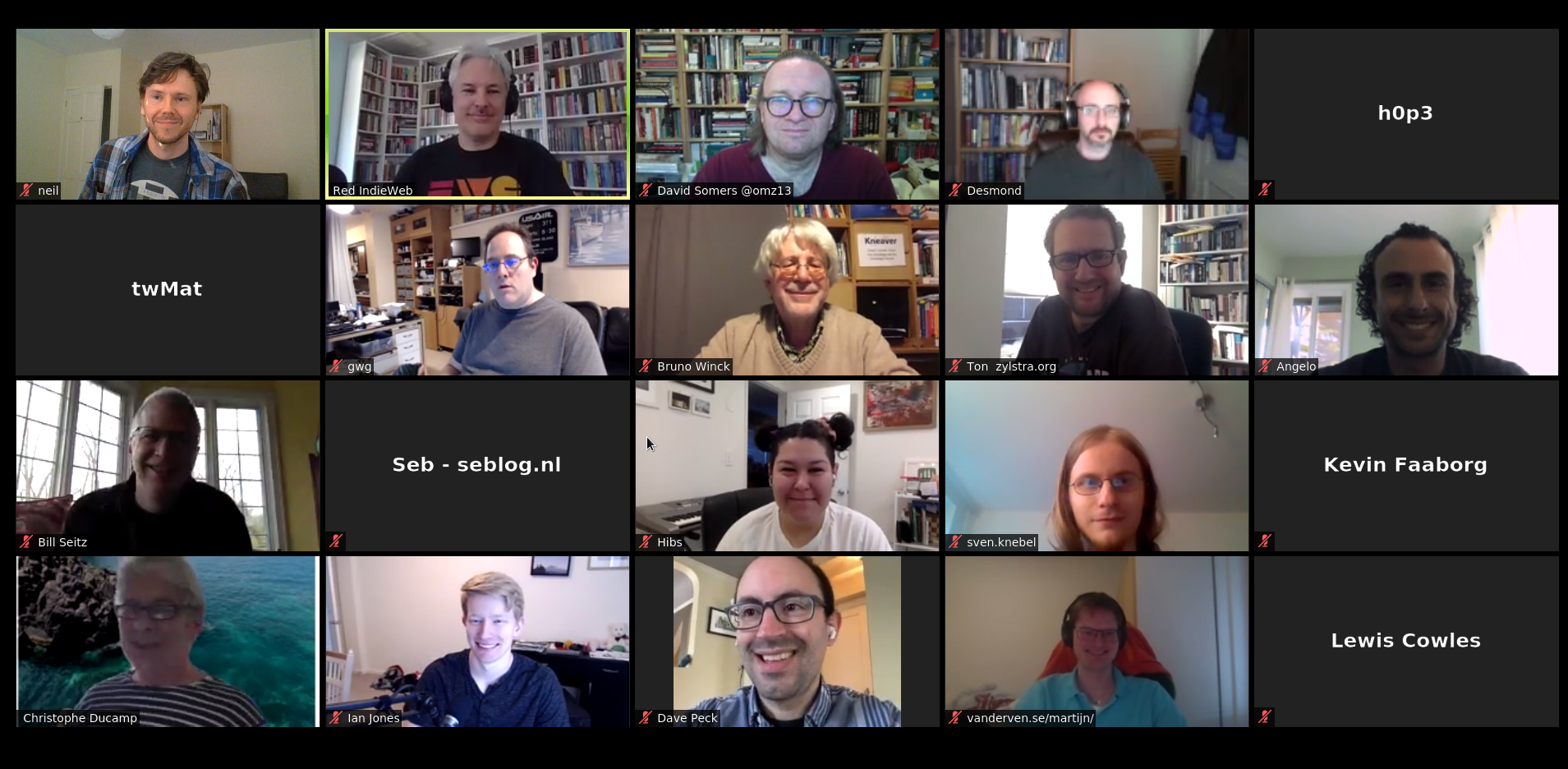
Around 25 people joined online over the course of the session.

indiewebcamp-gardenandstream.png

It was a wide-ranging discussion on lots of wiki-adjacent topics. One of the things I really liked was the plurality of both the reasons for having a wiki, and of the tools people use to do it. Very IndieWeb.

Some parts of it that stuck in my brain:

  • the link between the stream and the garden, and when you write in one or the other
  • what actually are personal wikis? What do people use them for?
  • mind maps, memory palaces
    • historical examples of externalising memories, like walkabouts
  • how do you structure your garden for yourself, and for others
    • is transclusion a good way to navigate ideas? Is the loss of narrative a problem?
  • bidirectional links or backlinks
    • renewed interest in this (is this thanks to Roam?), but mostly focused on internal backlinks in your own wiki
    • can we use webmentions as a mechanism for bidirectional links across sites?

There was way more discussed than that. I think given the interest and the breadth of topics, it would be fun to get together semi-regularly.

You can check out the notes and the recording for a lot more: The Garden and the Stream.

Prompted by a conversation with Ellie yesterday…

I sometimes think probably some appreciation comes from listening to the music in computer games as a kid. (And, maybe, for the more experimental stuff, the screech of the tape loader on the Amstrad… And the dial-up modem later on…)

The first electronic songs that I can remember? I remember my brother had a tape called ‘The Ultimate Rave‘, from 92. So that would have been around when I was 10. I remember the Charly song from that, although the album version is way better. I listened to Experience a lot. He also had ‘Rave 92‘, I still remember a bunch of tracks from that fondly… On A Ragga Tip, The Bouncer, Ravin’ I’m Raving.

So then The Prodigy, The Shamen, a bit later the Chemical Brothers. I have a distinct memory at some point of watching No Limits by 2 Unlimited on some music programme when at my grandparents house.

My Mum liked Orbital, so we had a bunch of their early albums around – Snivilisation, Insides, the brown one.

At some point (around college time I guess?), I started getting into IDM. Warp (Autechre, Boards of Canada) and Skam (Jega) being the labels that kicked me off. Where did that come from? I think that was me going off into my own territory at that point, possibly with some assist from Michael. I distinctly remember teaching myself how to make websites while listening to Tri Repetae on repeat. College? Pre-uni?

It’s mostly been the more IDM side of things since then.

I started my wiki with pretty long pages, lots of thoughts bunched together. I didn’t think that much about structure, as I just wanted somewhere to chuck my ideas, and it worked great. After building up it up for about a month or so, though, I started feeling the need for something that makes it easier to link concepts together.

That tends to then lead you to towards things like zettelkasten and the philosophy of tiddlers. Breaking everything up into small chunks that can be linked together (‘collecting the dots‘).

I like the way that TiddlyWiki and FedWiki do it. Roam seems to be the latest hot new thing along those lines. And I found org-roam has helped with this for my own setup.

There is much to be said for the zettelkasten / tiddler approach. But – also I think the long player is vital too. The occassional connecting of the dots into longer-forms (AKA articles). It’s a type of path or a thread of your ideas, made sense of and hand-curated at a point in time by yourself, to share with others. Sitting somewhere between the garden and the stream? It’s kind of an entry point into your garden that your share into the stream.

Lately, I’ve been hitting a rich seam of classic articles out there, 5 years old or more, that would have been lost in time if just in a stream, and replanted or paved over by now if just part of the garden.

(And, side note, some of my wiki pages are still pretty long.)

In a way, in terms of audience, I currently think of my personal wiki as ‘me first’, although not ‘me only’. A personal wiki could be completely private, and that’s a totally legit use case. However for me having it public has a big benefit – sharing my ideas and learning from feedback is a motivator to writing for me. But I think of it as ‘me first’, in that if there was some pressure to make it really polished, I would probably hardly ever write in it.

I think the important thing is whatever motivates you to write, at the same time as removing the friction. That probably changes from person to person.

I fixed a small issue in my theme that I’d noticed, where other people’s sites weren’t picking up my author details. The problem? My author info wasn’t included in the entries. I had a site-wide h-card but I hadn’t got it in the entries themselves.

The process for figuring out who has written a post is referred to as authorship, and the IndieWeb wiki page on it is very helpful. Also thanks to Sven for the help.

I just wrote a big ol’ blog post about indiewebifying my event discovery and RSVPs. Thinking about it just now, however, it’s a bit of a mish-mash between why I wanted to do it, and how I did it.

For someone coming to the post who is new to the IndieWeb, it’s probably bit off-putting (and maybe fuel for the fire of ‘IndieWeb is too complicated’). And for someone who already knows about the IndieWeb, but isn’t using WordPress, they might skip over the hows and in the process miss some of the whys.

So in future I might try and split these kinds of articles into two – a ‘why’ post, and a ‘how I did it’ post. The ‘why’ post will kind of be my behaviour-driven development specs, so to speak, and probably mostly links to various pattern pages on the IndieWeb wiki. And the ‘how’ post will get into the weeds of one very specific implementation, liberally referring back to the ‘why’ post.

I think that would work well and make the articles a bit more reusable and less niche.